Lesson 3

Temperature sensors

Thermocouple, RTD, thermistor, infrared, bimetallic.

The basic principle

A temperature sensor is a device that exploits some physical property which changes in a predictable, repeatable way as temperature changes. Different sensors use very different physics — a voltage between two metals, the resistance of a wire, the resistance of a semiconductor, the radiation an object emits, or the way two bonded metals bend at different rates — but in every case the temperature is inferred from a measurable quantity rather than read directly.

Contact vs. non-contact
Thermocouples, RTDs, thermistors and bimetallic strips all need to touch the thing they're measuring; they reach thermal equilibrium with it and then report that temperature. Infrared sensors don't touch anything — they read the heat radiated through air, which makes them essential for moving parts, hot surfaces, food and process safety scans, and any situation where physical contact is impossible or unsafe.
PRINCIPLE
Thermocouple
Two metals joined — heat → small voltage.
Heat sourceHot junctionCold junctionsSeebeck emf8.2 mV
The hot vs cold junctions produce a tiny voltage (Seebeck effect).
0:00 / 0:06
1

Thermocouple

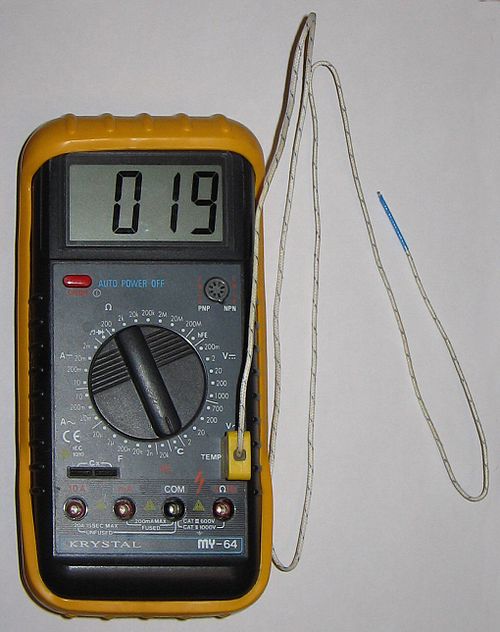
A thermocouple is a thermoelectric device used for measuring temperatures. A typical thermocouple is made up of two dissimilar metal wires joined together at either end. One junction is placed on the surface or in the environment that is being measured — this area is known as the hot junction. At the other end the wires are connected to a thermocouple-capable device such as a meter, controller or transmitter that remains at a constant known temperature, and this is called the cold junction.

Changing the temperature at the hot junction will generate a small millivolt signal. This occurs because when metal is heated, the electrons in the metal move around more and tend to drift away from the heat source toward the cold junction. Since the two wires are made of different metals, the electrons drift at different rates. The wire whose electrons move more will have a negative charge at the cold junction, while the wire whose electrons move less makes up the positive lead.

From the difference between the positive and negative leads, a formula — a calibration curve specific to that thermocouple type — is used to convert the output voltage into a temperature value. Thermocouples are rugged, cheap, and cover an enormous range from cryogenics up to well over a thousand degrees, which is why they dominate industrial temperature measurement.
PRINCIPLE
RTD (Pt100)
Resistance rises linearly with temperature.
Platinum wire windingR ≈ R₀ (1 + αΔT)116.0 Ω
A pure metal coil — predictable, almost linear resistance vs. temperature.
0:00 / 0:06
2

RTD (resistance temperature detector)

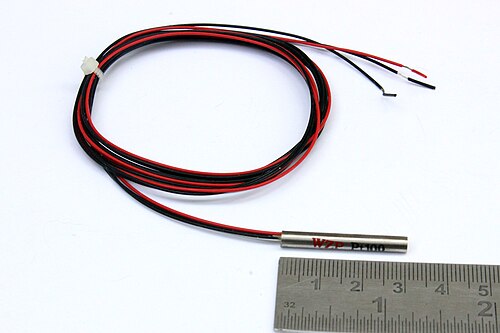
A resistance temperature detector, or RTD, measures temperature by reading the resistance of a precisely-made coil of pure metal. The metal of choice is almost always platinum, because its resistance increases in an almost perfectly linear way with temperature and because it is chemically stable over a very wide range. The most common variant is the Pt100, a sensor whose resistance is exactly one hundred ohms at zero degrees Celsius.

Inside the probe, the platinum wire is wound onto a small ceramic former or deposited as a thin film on a ceramic substrate, and the whole assembly is sealed inside a stainless-steel sheath. A small known current is passed through the winding, and the voltage that develops across it is measured. From Ohm's law the resistance can be calculated, and a simple equation then converts that resistance into temperature.

RTDs are slower to respond than thermocouples because the platinum and its sheath have to thermally equilibrate with the process, but in return they are dramatically more accurate and far more stable over time. They are the standard choice for laboratory measurement, calibration work, food and pharmaceutical processing, and any application where the temperature really has to be right.

PRINCIPLE
Thermistor (NTC)
Semiconductor bead — steep, non-linear.
NTC beadResistance vs. temperature5.0 kΩ
Cheap and very sensitive — but the curve is non-linear and the range is narrow.
0:00 / 0:06
3

Thermistor

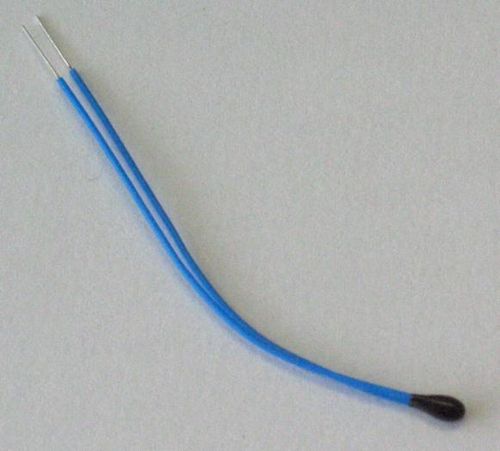
A thermistor is a temperature sensor made from a small bead of specially-formulated semiconductor material. Like an RTD, it works by changing its electrical resistance with temperature, but the underlying physics is different and the result is much more dramatic. The most common type, the NTC — negative temperature coefficient — thermistor, sees its resistance fall sharply as it warms up.

The bead is typically a sintered mixture of metal oxides with two wire leads attached, encapsulated in glass or epoxy. A small current is passed through it, the voltage is measured, and the resistance is calculated. Because the resistance can change by a factor of ten or more across only a few tens of degrees, even cheap electronics can detect small temperature changes with high resolution.

The trade-off is range and linearity. A thermistor's response curve is steeply non-linear, so the conversion from resistance to temperature usually relies on a lookup table or a polynomial fit specific to that bead. They are inexpensive, very fast to respond because the bead is so small, and ideal for narrow-range work — battery packs, HVAC, medical thermometers, automotive coolant — but they are not the right choice for very high or very low temperatures.

PRINCIPLE
Infrared
Read radiated heat — no contact.
Hot objectIR detectorInferred temperature101 °C
Optics focus emitted IR onto a detector — works on moving or unreachable targets.
0:00 / 0:06
4

Infrared (pyrometer)

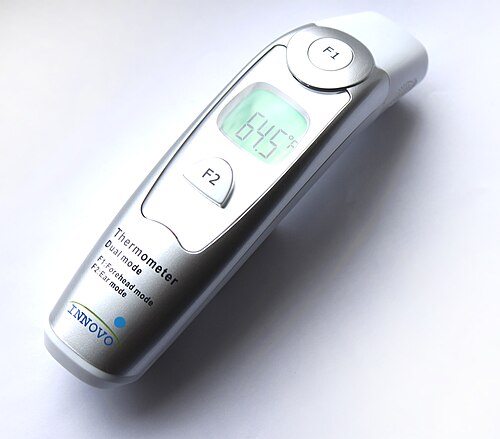
An infrared temperature sensor, sometimes called a pyrometer, measures temperature without touching the object at all. Every surface above absolute zero radiates electromagnetic energy, and the hotter it is, the more energy it radiates and the shorter the wavelengths shift toward. An infrared sensor uses a lens to focus this radiation from a small spot on the target onto a detector — either a thermopile that produces a voltage when warmed, or a more modern micro-bolometer array.

The electronics convert the detected radiation into a temperature reading, after compensating for the emissivity of the surface being measured. Emissivity is a number between zero and one that describes how efficiently a particular surface radiates compared to a perfect blackbody; polished metals are low, oxidised surfaces and most paints are close to one. Getting the emissivity right is essential to getting an accurate reading.

Because there is no physical contact, infrared sensors are the natural choice for moving objects, very hot surfaces, food on a conveyor, molten metal in a foundry, motor windings, and electrical hot spots in a switchboard. They respond in milliseconds and can read through windows transparent to infrared, but they are easily fooled by steam, smoke, or a reflective surface that is bouncing radiation from elsewhere in the room.

PRINCIPLE
Bimetallic
Two bonded metals expand at different rates.
Heat appliedMetal A — high expansionMetal B — low expansion→ moves contact / pointer
As it heats, the strip curls — the free end drives a switch or pointer.
0:00 / 0:06
5

Bimetallic strip

A bimetallic strip is the simplest temperature sensor of all and uses no electronics whatsoever. It is made by bonding two thin layers of different metals — typically a high-expansion alloy on one side and a low-expansion alloy on the other — back to back along their entire length. Both metals expand when heated, but at very different rates.

Because the two layers are rigidly joined, they cannot expand independently. As the strip warms, the high-expansion side tries to grow longer than the low-expansion side, and the strip has no choice but to curl toward the slower-growing layer. Cool the strip back down and it straightens again. The amount of curl is repeatable and proportional to the temperature change, so the free end of the strip moves a predictable distance.

That movement can drive a pointer on a dial thermometer, open and close electrical contacts in a mechanical thermostat, or trip a circuit breaker when current heats the strip enough to bend. They are slow, low-resolution, and limited to a moderate temperature range, but they need no power, never fail electronically, and are still the right tool for cheap, reliable mechanical temperature switching.

How to pick one (rule of thumb)
Wide range, robust, cheap → thermocouple. High accuracy and stability → RTD. Small range with fast response → thermistor. Moving or unreachable target → infrared. Purely mechanical trip or dial → bimetallic.