Lesson 6

Fluid level sensors

Float, capacitive, ultrasonic, radar, hydrostatic, conductivity.

The basic principle

A fluid level sensor tells the controller how much liquid is sitting inside a tank, sump or vessel. The reading can be continuous — a percentage or a height that varies smoothly from empty to full — or it can be a discrete point switch that only fires when the liquid reaches one specific height. The physics ranges from a literal floating ball to microwaves bouncing off the surface, but in every case the sensor is trying to find where the air ends and the liquid begins.

Continuous vs. point level
Continuous sensors give a level value you can use directly for control — a float on a rod with a potentiometer, a radar reading the surface from above, a pressure tap at the bottom of the tank. Point sensors only switch on or off when the liquid reaches a specific height — conductivity probes at pre-set levels, vibrating tuning forks, simple float switches. Most real installations combine the two: one continuous sensor for normal control, and a couple of point switches as independent high- and low-level alarms for safety.
PRINCIPLE
Float
A buoyant ball rides the surface.
25 %
The float rises with the liquid — a lever or magnet reads its position.
0:00 / 0:08
1

Float

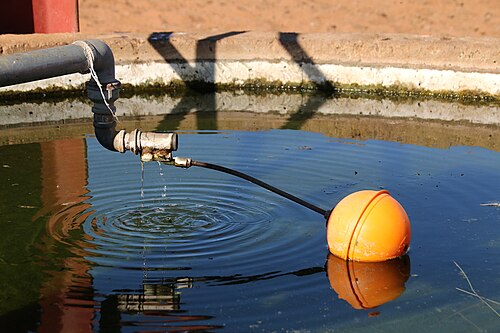
A float level sensor is the oldest and most intuitive technology of all. A buoyant ball or hollow cylinder is placed inside the tank and naturally rides on the surface of the liquid. As the liquid level rises and falls, the float rises and falls with it, and the rest of the sensor mechanism translates the float's position into a usable signal.

The simplest implementations use a lever and rod, like an old toilet cistern: the float is on one end of a pivoting arm, and the other end drives a pointer, opens a contact, or rotates the wiper of a potentiometer to produce a voltage. More refined versions use a vertical guide tube with a magnet inside the float and a chain of reed switches along the outside of the tube, so that as the float passes each switch the level reading steps up.

Floats are mechanically simple, need no electrical power for the basic mechanism, and are immune to whether the liquid is conductive or not. The drawbacks are that the float can stick from product build-up over time, can be damaged by turbulent fills, and gives only as fine a resolution as the mechanism allows. They are still a sound choice for cheap, robust, indicative level measurement.
PRINCIPLE
Capacitive
Probe + wall form a capacitor.
ProbeCapacitance270 pF
Liquid replaces air around the probe → dielectric changes → capacitance rises.
0:00 / 0:08
2

Capacitive

A capacitive level sensor takes advantage of the fact that air and liquid have very different dielectric constants — the property that determines how much electric charge can be stored in the gap between two conductive surfaces. A long, insulated metal probe is lowered vertically into the tank, and the metal wall of the tank itself acts as the second electrode.

The probe and the wall together form a long, thin capacitor running the full height of the tank. When the tank is empty, the gap between them is filled with air, which has a low dielectric constant and so the capacitance is small. As liquid rises around the probe, it replaces the air with a material whose dielectric constant is much higher, and the capacitance of the probe-to-wall capacitor rises in proportion to how much of the probe is now submerged.

The electronics measure that capacitance with a high-frequency excitation signal and convert it into a level reading. Capacitive sensors handle liquids, slurries, and even some powders, have no moving parts, and need only a single probe. The catch is that they must be calibrated for the specific liquid being measured, because changing the product changes its dielectric constant and shifts the calibration.

PRINCIPLE
Ultrasonic
Ping the surface, time the echo.
TransducerDistance → level25 %
Distance = ½ × speed of sound × echo time. Non-contact, affected by foam.
0:00 / 0:08
3

Ultrasonic

An ultrasonic level sensor sits on top of the tank pointing down at the liquid surface, like a sonar pinging the bottom of a lake. It contains a piezoelectric transducer that emits a short burst of high-frequency sound, typically somewhere between twenty and two hundred kilohertz, well above the range of human hearing.

The sound pulse travels down through the air inside the tank, reflects off the liquid surface, and returns to the transducer, which now acts as a microphone and detects the echo. The electronics measure the time between transmission and echo — the time of flight — and use the known speed of sound in air to calculate the distance from the sensor to the liquid surface. Subtracting that distance from the known height of the tank gives the level.

Because the sensor never touches the liquid, it is naturally suited to corrosive, sticky, or fouling fluids that would damage a contact sensor. The limitations are environmental: dense vapour, thick foam on the surface, strong air currents, and large temperature swings all change the speed of sound and degrade the reading. Ultrasonic is the right choice for open tanks of clean, well-behaved liquids.

PRINCIPLE
Radar
Microwaves reflect off the surface.
Horn antennaLevel25 %
Microwaves cut through vapour, dust, and pressure — works where ultrasonic fails.
0:00 / 0:08
4

Radar

A radar level sensor works on the same principle as ultrasonic — fire a signal down at the liquid, time the echo back — but uses microwaves instead of sound. A horn antenna or a guided wave probe mounted at the top of the tank transmits short pulses of microwave energy, or a continuous frequency-swept signal in the more modern FMCW designs, and listens for the reflection from the liquid surface.

Because microwaves travel at the speed of light, the time of flight is measured to a precision of picoseconds, and the electronics convert it into a distance and then a level reading. The wavelength is short enough that the sensor can resolve liquid surfaces with millimetre accuracy across tank heights of tens of metres.

Radar's great strength is its insensitivity to the things that defeat ultrasonic. Vapour, dust, foam, varying temperature, varying pressure, and even moderate turbulence have very little effect on a microwave pulse. That makes radar the standard for sealed pressurised vessels, distillation columns, hot bitumen tanks, chemical reactors, and any other process where the headspace above the liquid is far from a clean room. The trade-off is cost — radar transmitters are noticeably more expensive than ultrasonic or hydrostatic alternatives.

PRINCIPLE
Hydrostatic
Pressure at the bottom = density × g × height.
Pressure sensorBottom pressure90 mbar
Measure the pressure at the bottom — it's proportional to liquid height.
0:00 / 0:08
5

Hydrostatic

A hydrostatic level sensor measures level indirectly, by reading the pressure that a column of liquid exerts on a sensor at the bottom of the tank. The pressure at the bottom of any standing column of liquid is given by the simple equation P = ρ·g·h: density times the acceleration of gravity times the height of the liquid above the sensor.

In practice the sensor is a pressure transmitter, usually a strain gauge or piezoresistive type, either mounted on a tapping in the side of the tank near the bottom or submerged at the end of a cable. The pressure it reads at any moment is directly proportional to the height of liquid above it. Knowing the fluid's density, the electronics convert that pressure into a level value.

For an open tank that's the whole story. For a closed pressurised vessel, the gas pressure above the liquid adds to the bottom reading, so a second transmitter measures the headspace pressure and the difference between the two — a differential pressure measurement — gives the true hydrostatic head. Hydrostatic level is cheap, simple, and very common on water, fuel, and chemical tanks, but it depends on knowing the density of the fluid accurately.

PRINCIPLE
Conductivity
Probes wet ↔ dry — point switches.
Hi ○ DRYMid ○ DRYLo ● WET
When liquid bridges two probes, current flows — simple high/low alarm.
0:00 / 0:08
6

Conductivity

A conductivity level sensor uses the fact that most liquids — water and aqueous solutions in particular — conduct a small amount of electric current, while the air above the liquid does not. The sensor consists of two or more metal probes mounted at known heights inside the tank, with their conductive tips exposed and the rest of the probe insulated.

A small AC voltage is applied between any pair of probes, or between a single probe and the metal tank wall. When the liquid level is below both probes, the air gap between them blocks the current and the circuit is open. The moment liquid rises and bridges the two probes, it provides a low-resistance path between them and a small current flows. The electronics detect that current and switch a relay, signalling that the level has reached that probe.

Conductivity probes are inherently point-level switches, not continuous sensors. A typical installation has a low-level probe near the bottom — to switch a pump on when the tank empties — and a high-level probe near the top to switch the pump off when the tank fills. They are cheap, simple, and reliable, but only work with conductive liquids, which rules out oils, hydrocarbons, and pure distilled water.

How to pick one (rule of thumb)
Cheap and mechanical → float. Closed pressurised vessel → hydrostatic. Foam-, vapour-, or pressure-heavy → radar. Open tank, clean → ultrasonic. Conductive liquid + need a simple alarm point → conductivity.