Strain gauge
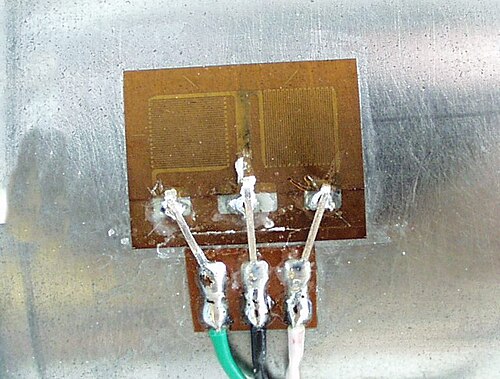
A strain gauge pressure sensor uses the fact that when a metal wire or foil is stretched, its electrical resistance changes. A very thin foil pattern is bonded onto a metal diaphragm with a special adhesive so that the foil moves exactly with the diaphragm.
When pressure is applied, the diaphragm bends inward by a tiny amount — usually a few thousandths of a millimetre. The foil bonded to its surface stretches with it, which lengthens and thins the metal track and increases its resistance. Release the pressure and the diaphragm springs back, the foil relaxes, and the resistance returns to its starting value.
Because the resistance change is small, four gauges are usually wired into a Wheatstone bridge — two stretched in tension, two compressed — and the bridge output is amplified to give a clean voltage proportional to pressure. Strain gauge sensors are robust, work over a wide pressure range, and are the workhorse of industrial pressure measurement.